 Add to Chrome
 Add to Firefox
 Add to Edge
Reward Shaping for Inference-Time Alignment: A Stackelberg Game Perspective
Jan 31, 2026
Existing alignment methods directly use the reward model learned from user preference data to optimize an LLM policy, subject to KL regularization with respect to the base policy. This practice is suboptimal for maximizing user's utility because the KL regularization may cause the LLM to inherit the bias in the base policy that conflicts with user preferences. While amplifying rewards for preferred outputs can mitigate this bias, it also increases the risk of reward hacking. This tradeoff motivates the problem of optimally designing reward models under KL regularization. We formalize this reward model optimization problem as a Stackelberg game, and show that a simple reward shaping scheme can effectively approximate the optimal reward model. We empirically evaluate our method in inference-time alignment settings and demonstrate that it integrates seamlessly into existing alignment methods with minimal overhead. Our method consistently improves average reward and achieves win-tie rates exceeding 66% against all baselines, averaged across evaluation settings.

Latent Spherical Flow Policy for Reinforcement Learning with Combinatorial Actions
Jan 29, 2026Reinforcement learning (RL) with combinatorial action spaces remains challenging because feasible action sets are exponentially large and governed by complex feasibility constraints, making direct policy parameterization impractical. Existing approaches embed task-specific value functions into constrained optimization programs or learn deterministic structured policies, sacrificing generality and policy expressiveness. We propose a solver-induced \emph{latent spherical flow policy} that brings the expressiveness of modern generative policies to combinatorial RL while guaranteeing feasibility by design. Our method, LSFlow, learns a \emph{stochastic} policy in a compact continuous latent space via spherical flow matching, and delegates feasibility to a combinatorial optimization solver that maps each latent sample to a valid structured action. To improve efficiency, we train the value network directly in the latent space, avoiding repeated solver calls during policy optimization. To address the piecewise-constant and discontinuous value landscape induced by solver-based action selection, we introduce a smoothed Bellman operator that yields stable, well-defined learning targets. Empirically, our approach outperforms state-of-the-art baselines by an average of 20.6\% across a range of challenging combinatorial RL tasks.
Policy-Embedded Graph Expansion: Networked HIV Testing with Diffusion-Driven Network Samples
Jan 20, 2026HIV is a retrovirus that attacks the human immune system and can lead to death without proper treatment. In collaboration with the WHO and Wits University, we study how to improve the efficiency of HIV testing with the goal of eventual deployment, directly supporting progress toward UN Sustainable Development Goal 3.3. While prior work has demonstrated the promise of intelligent algorithms for sequential, network-based HIV testing, existing approaches rely on assumptions that are impractical in our real-world implementations. Here, we study sequential testing on incrementally revealed disease networks and introduce Policy-Embedded Graph Expansion (PEGE), a novel framework that directly embeds a generative distribution over graph expansions into the decision-making policy rather than attempting explicit topological reconstruction. We further propose Dynamics-Driven Branching (DDB), a diffusion-based graph expansion model that supports decision making in PEGE and is designed for data-limited settings where forest structures arise naturally, as in our real-world referral process. Experiments on real HIV transmission networks show that the combined approach (PEGE + DDB) consistently outperforms existing baselines (e.g., 13% improvement in discounted reward and 9% more HIV detections with 25% of the population tested) and explore key tradeoffs that drive decision quality.
Health Facility Location in Ethiopia: Leveraging LLMs to Integrate Expert Knowledge into Algorithmic Planning
Jan 16, 2026Ethiopia's Ministry of Health is upgrading health posts to improve access to essential services, particularly in rural areas. Limited resources, however, require careful prioritization of which facilities to upgrade to maximize population coverage while accounting for diverse expert and stakeholder preferences. In collaboration with the Ethiopian Public Health Institute and Ministry of Health, we propose a hybrid framework that systematically integrates expert knowledge with optimization techniques. Classical optimization methods provide theoretical guarantees but require explicit, quantitative objectives, whereas stakeholder criteria are often articulated in natural language and difficult to formalize. To bridge these domains, we develop the Large language model and Extended Greedy (LEG) framework. Our framework combines a provable approximation algorithm for population coverage optimization with LLM-driven iterative refinement that incorporates human-AI alignment to ensure solutions reflect expert qualitative guidance while preserving coverage guarantees. Experiments on real-world data from three Ethiopian regions demonstrate the framework's effectiveness and its potential to inform equitable, data-driven health system planning.
Beyond Majority Voting: LLM Aggregation by Leveraging Higher-Order Information
Oct 01, 2025With the rapid progress of multi-agent large language model (LLM) reasoning, how to effectively aggregate answers from multiple LLMs has emerged as a fundamental challenge. Standard majority voting treats all answers equally, failing to consider latent heterogeneity and correlation across models. In this work, we design two new aggregation algorithms called Optimal Weight (OW) and Inverse Surprising Popularity (ISP), leveraging both first-order and second-order information. Our theoretical analysis shows these methods provably mitigate inherent limitations of majority voting under mild assumptions, leading to more reliable collective decisions. We empirically validate our algorithms on synthetic datasets, popular LLM fine-tuning benchmarks such as UltraFeedback and MMLU, and a real-world healthcare setting ARMMAN. Across all cases, our methods consistently outperform majority voting, offering both practical performance gains and conceptual insights for the design of robust multi-agent LLM pipelines.
Generative AI Against Poaching: Latent Composite Flow Matching for Wildlife Conservation
Aug 20, 2025
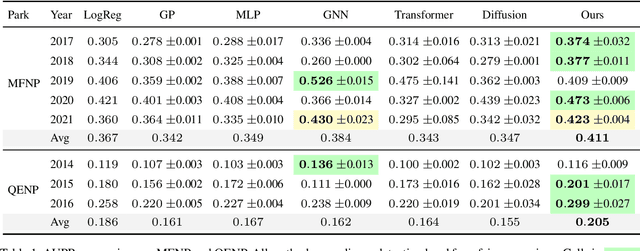
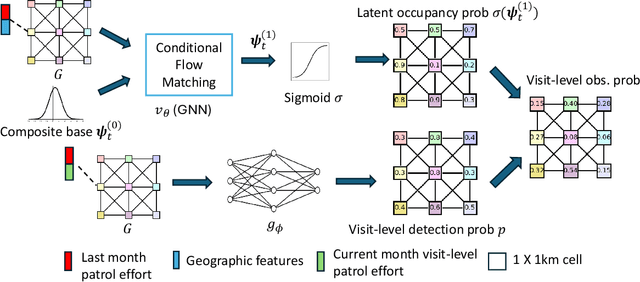
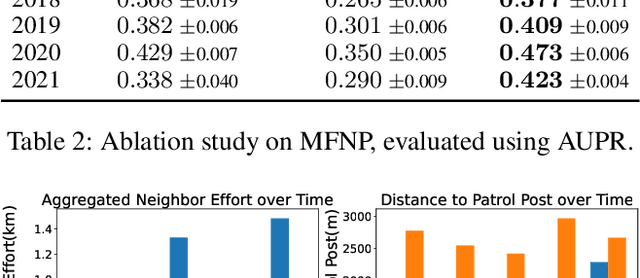
Poaching poses significant threats to wildlife and biodiversity. A valuable step in reducing poaching is to forecast poacher behavior, which can inform patrol planning and other conservation interventions. Existing poaching prediction methods based on linear models or decision trees lack the expressivity to capture complex, nonlinear spatiotemporal patterns. Recent advances in generative modeling, particularly flow matching, offer a more flexible alternative. However, training such models on real-world poaching data faces two central obstacles: imperfect detection of poaching events and limited data. To address imperfect detection, we integrate flow matching with an occupancy-based detection model and train the flow in latent space to infer the underlying occupancy state. To mitigate data scarcity, we adopt a composite flow initialized from a linear-model prediction rather than random noise which is the standard in diffusion models, injecting prior knowledge and improving generalization. Evaluations on datasets from two national parks in Uganda show consistent gains in predictive accuracy.
Beyond Listenership: AI-Predicted Interventions Drive Improvements in Maternal Health Behaviours
Jul 28, 2025Automated voice calls with health information are a proven method for disseminating maternal and child health information among beneficiaries and are deployed in several programs around the world. However, these programs often suffer from beneficiary dropoffs and poor engagement. In previous work, through real-world trials, we showed that an AI model, specifically a restless bandit model, could identify beneficiaries who would benefit most from live service call interventions, preventing dropoffs and boosting engagement. However, one key question has remained open so far: does such improved listenership via AI-targeted interventions translate into beneficiaries' improved knowledge and health behaviors? We present a first study that shows not only listenership improvements due to AI interventions, but also simultaneously links these improvements to health behavior changes. Specifically, we demonstrate that AI-scheduled interventions, which enhance listenership, lead to statistically significant improvements in beneficiaries' health behaviors such as taking iron or calcium supplements in the postnatal period, as well as understanding of critical health topics during pregnancy and infancy. This underscores the potential of AI to drive meaningful improvements in maternal and child health.
Composite Flow Matching for Reinforcement Learning with Shifted-Dynamics Data
May 29, 2025Incorporating pre-collected offline data from a source environment can significantly improve the sample efficiency of reinforcement learning (RL), but this benefit is often challenged by discrepancies between the transition dynamics of the source and target environments. Existing methods typically address this issue by penalizing or filtering out source transitions in high dynamics-gap regions. However, their estimation of the dynamics gap often relies on KL divergence or mutual information, which can be ill-defined when the source and target dynamics have disjoint support. To overcome these limitations, we propose CompFlow, a method grounded in the theoretical connection between flow matching and optimal transport. Specifically, we model the target dynamics as a conditional flow built upon the output distribution of the source-domain flow, rather than learning it directly from a Gaussian prior. This composite structure offers two key advantages: (1) improved generalization for learning target dynamics, and (2) a principled estimation of the dynamics gap via the Wasserstein distance between source and target transitions. Leveraging our principled estimation of the dynamics gap, we further introduce an optimistic active data collection strategy that prioritizes exploration in regions of high dynamics gap, and theoretically prove that it reduces the performance disparity with the optimal policy. Empirically, CompFlow outperforms strong baselines across several RL benchmarks with shifted dynamics.
Adaptive Frontier Exploration on Graphs with Applications to Network-Based Disease Testing
May 27, 2025We study a sequential decision-making problem on a $n$-node graph $G$ where each node has an unknown label from a finite set $\mathbf{\Sigma}$, drawn from a joint distribution $P$ that is Markov with respect to $G$. At each step, selecting a node reveals its label and yields a label-dependent reward. The goal is to adaptively choose nodes to maximize expected accumulated discounted rewards. We impose a frontier exploration constraint, where actions are limited to neighbors of previously selected nodes, reflecting practical constraints in settings such as contact tracing and robotic exploration. We design a Gittins index-based policy that applies to general graphs and is provably optimal when $G$ is a forest. Our implementation runs in $O(n^2 \cdot |\mathbf{\Sigma}|^2)$ time while using $O(n \cdot |\mathbf{\Sigma}|^2)$ oracle calls to $P$ and $O(n^2 \cdot |\mathbf{\Sigma}|)$ space. Experiments on synthetic and real-world graphs show that our method consistently outperforms natural baselines, including in non-tree, budget-limited, and undiscounted settings. For example, in HIV testing simulations on real-world sexual interaction networks, our policy detects nearly all positive cases with only half the population tested, substantially outperforming other baselines.
Analyzing Cost-Sensitive Surrogate Losses via $\mathcal{H}$-calibration
Feb 26, 2025This paper aims to understand whether machine learning models should be trained using cost-sensitive surrogates or cost-agnostic ones (e.g., cross-entropy). Analyzing this question through the lens of $\mathcal{H}$-calibration, we find that cost-sensitive surrogates can strictly outperform their cost-agnostic counterparts when learning small models under common distributional assumptions. Since these distributional assumptions are hard to verify in practice, we also show that cost-sensitive surrogates consistently outperform cost-agnostic surrogates on classification datasets from the UCI repository. Together, these make a strong case for using cost-sensitive surrogates in practice.